Global Workshop on Earth Observation with Julia 2024

Global Workshop on Earth Observation with Julia 2024

JuliaEO 2024 - Global Workshop on Earth Observation with Julia 2024

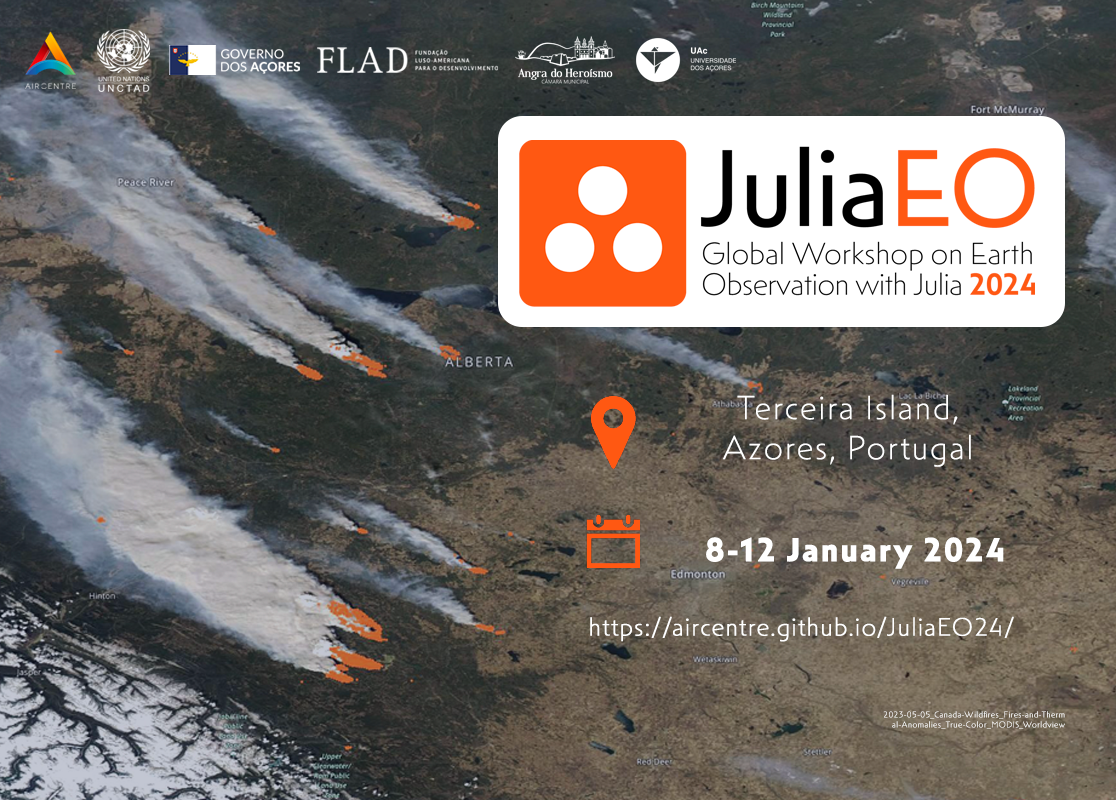
January 8 - 12, 2024 The training workshop jointly organised by the Atlantic International Research Centre (AIR Centre) and the United Nations Conference on Trade and Development (UNCTAD) aims at developing the computer programming skills of those working on Earth Observation, including the members of the Earth Observation Laboratory (EO Lab) and other laboratories. To stimulate collaboration beyond the training, the workshop is in person (full week). However, due to the high level of interest, remote participation is also possible. Remote participants will be able to watch the sessions live. Remote active participation is possible but limited to text chat. The topics covered include acquisition, processing, visualisation, and classification of Earth Observation data, using the Julia programming language. The training workshop will emphasise practical activities including the use of datasets, libraries/packages, automated workflows, Artificial Intelligence (AI), and classification algorithms. Theory-oriented sessions will introduce the concepts and hands-on activities. The open-source Julia language is relatively recent. It was created at the Massachusetts Institute of Technology (MIT), first released in 2012, and reached the v1.0 milestone in 2018. Julia has a vocation for high-performance scientific computing, making it today’s ideal choice to work on resource-intensive datasets such as the Earth Observation ones. Mutual benefits expected to arise from the collaboration of the AIR Centre and the Julia community include:
  • Capacity building for invited institutions.
  • Create collaboration opportunities between the participants and speakers.
  • Create the potential to extend the Portuguese contribution to the scientific community.
  • Bringing together the two communities around Julia: developers and end-users.
  • Opening new avenues for collaboration on both software and science.
  • Contributing to strengthening the open source / science community.
  • Creating an axis of collaboration to study the Azores region using Earth Observation, numerical models, and data products.
  • Finding new prospective contributors to Julia packages; helping developers build up their user community; identifying needs and desired new features.
  • Providing additional exposure for the products and activity of the AIR Centre; via US and EU growing Julia communities.
Know more on the event website.
Share this entry

Other News

Collaboration

Space Agencies shape regional priorities at the II Ibero-American Meeting in Madrid

calendar_today September 17, 2026

The AIR Centre took part in the II Ibero-American Space Agencies Meeting in Madrid, organised by the Spanish Space Agency on 15 and 16 September. AIR Centre’s Deputy Executive Director, Mafalda Carapuço, represented the organisation alongside heads of space agencies, universities, research centres and industry from across the Ibero-American community.

Collaboration

ATLANTICO_SARG project officially launched to tackle Sargassum impacts through science and collaboration

calendar_today September 11, 2026

On September 10, partners from AIR Centre (Portugal), UNAM (Mexico) and IMar (Cabo Verde) held the kick-off meeting for ATLANTICO_SARG, a new triangular cooperation project funded under the second Call of the SEGIB / Camões, I.P. Triangular Cooperation Fund. Held online, the meeting brougtht together researchers and representatives from all three partner institutions to address the growing impact of Sargassum seaweed flooding on Cabo Verde's coasts.

Collaboration

Australian Ambassador strengthens scientific and diplomatic engagement during visit to the AIR Centre

calendar_today September 11, 2026

The Australian Ambassador to Portugal, Dr. Helen Cheney, who also serves as Ambassador to Cabo Verde, Guinea Bissau and Sao Tome and Principe, visited the AIR Centre on Terceira Island as part of her official programme in the Azores. The visit emphasized scientific cooperation and the growing relevance of the Atlantic in Australia’s international engagement.