TOTAL SUSPENDED MATTER (TSM)
TSM is measured in mg/L, and indicates the amount of suspended particles in water bodies, thus can be considered a parameter to evaluate the turbidity of water and its health. Some of these particles are present naturally in river and sea waters, such as plankton, fine plant debris and minerals, while others stem from human activity (organic and inorganic matter). As TSM levels increase, the appearance of the water becomes cloudier as light penetration decreases which has a negative impact on river and sea biology and can affect photosynthesis with important effects on biogeochemistry and life itself. High TSM levels can also clog fish gills, either killing them or reducing their growth rate. The concentration of TSM has been analyzed before and after the COVID-19 in the coast of Portugal to understand if any changes had occurred. The following pictures illustrate the TSM for one single day per month along 4 months. This parameter is a result of multiple factors which doesn’t allow to visualize immediate changes due to the COVID-19 outbreak. It is still too early to take conclusions concerning TSM.
Ocean and Land Colour Instrument (OLCI) on board Europe’s Sentinel-3A and 3B satellites with full resolution have 300m ground spatial resolution. With a total of 21 spectral bands, reflectance is measured in B8, B6 (wavelengths of 665 and 560nm) and B11 (wavelengths 709nm) bands are used for TSM for marine and inland water
Images Credit: Copernicus Online Data Access (CODA) - EUMESTAT
NORMALIZED DIFFERENCE VEGETATION INDEX (NDVI)
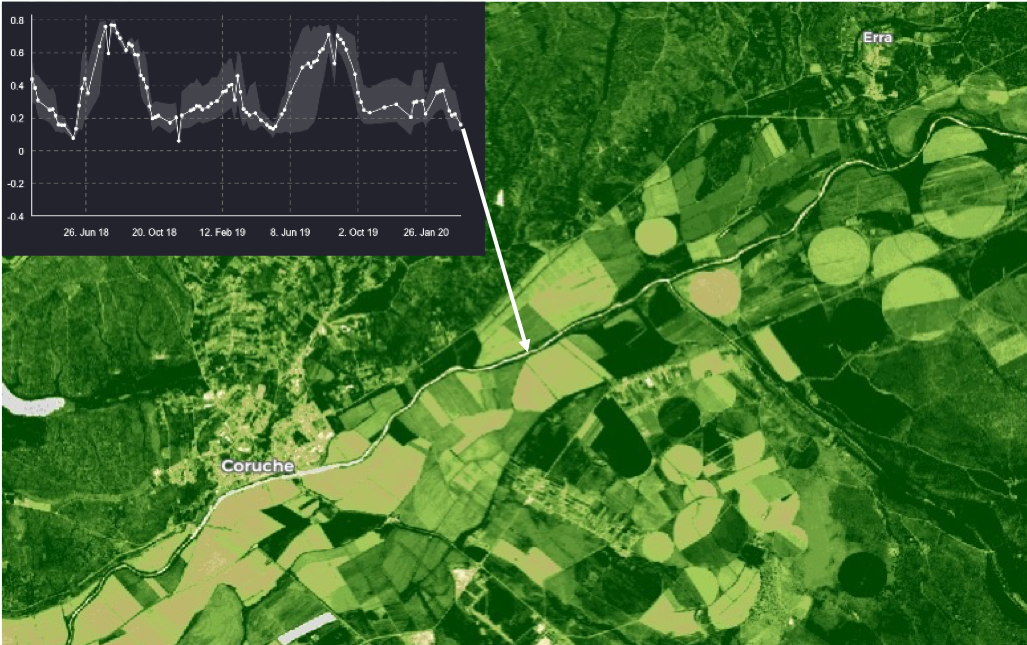
NDVI quantifies vegetation by measuring the difference between near-infrared (which vegetation strongly reflects) and red light (which vegetation absorbs) ranging from -1 to 1, with higher values indicating greater plant health. It normalizes green leaf scattering in the Near Infra-red wavelength and chlorophyll absorption in the red wavelength.
MultiSpectral Instrument (MSI) on board Europe’s Sentinel-2A and 2B satellites with spatial resolution that goes from 10 to 60m, with a total of 13 spectral bands ranging from the visible to the shortwave infrared (SWIR). NVDI uses B8 and B4 bands.
For example, satellite based NVDI can be used to follow production of corn to understand if changes occurring may have an impact on economy and food chain. In Portugal this staple crop category occupies 9% of the total cropping area and is mainly used for animal feed and for commercial starch production. The Portuguese dependence of corn imports is high: only 25% of the corn consumed in Portugal, in 2018, was produced in the country. This is changing as in 2018 the Portuguese government set the goal of self-provisioning in corn of 50%. The NDVI for the regions of Santarém and Coruche are given as example here for March 2020 (month in which around sowing is taking place) and August 2019 (month on which harvesting corn are green before harvesting in around October). Although too early to draw conclusions, satellite-based earth observation can be used to closely follow corn production in these and other regions.
Images Credit: European Union, contains modified Copernicus Sentinel data 2020 processed with EO browser
NITROGEN DIOXIDE (NO2)
NO
2 is generated by vehicles, heavy industry and power plants, some of which have been shut down during the corona virus pandemic. The main effects of breathing NO
2 relates to the increase of probability of respiratory problems as in high doses it could inflame the lining of the lungs and reduce immunity to lung infections, causing problems like coughing, colds and bronchitis.
Tropospheric Monitoring Instrument (TROPOMI) on board Europe’s Sentinel 5P satellite with a resolution of up to 7 x 3.5 km. TROPOMI is an imaging spectrometer covering wavelength bands between the ultraviolet and the shortwave infrared. Data is used by CAMS for analysis.
The following images depict the timeline of NO2 emissions in detail for Portugal and Spain and less detailed for Atlantic region, based on CAMS (Copernicus Atmosphere Monitoring Service) generated for 13h UTC at surface level for several days, before and after the COVID outbreak in Portugal. Images show a significant reduction in NO2 contamination levels due to reduced industrial activity.
Images Credit: Images generated using Copernicus CAMS Information
Another important aspect that can be seen in these images is maritime traffic passing in the Strait of Gibraltar, which is a sign that maritime commercial activities continue to operate. It is also possible to observe a reduction in Europe but to a much less extent in the USA.
Images Credit: Images generated using ECMWF CAMS Information
This report includes contributions from EO Lab Team and the following invitees: Teresa Brás (
CENSE, FCT NOVA, Portugal) and Telmo Vieira (
Univ of Porto, Portugal)
Disclaimer: neither AIR Centre, the European Commission nor ECMWF is responsible for any use that may be made of the information this report contains. Images generated using CAMS Information, contains modified CAMS Information 2020 and 2019.
Download the report #2
here.
 Research