Internal Waves Service
The Internal Waves Service (IWS) finds internal solitary waves (ISWs) in Copernicus Sentinel-1 imagery without human intervention, on imagery ingested in near-real-time as it is acquired. Coordinated by the AIR Centre with an international network of partners, it turns more than a decade of satellite acquisitions into an open and continuously growing record of where these waves occur.
Why internal waves matter
ISWs are among the most energetic features in the ocean. They propagate along the pycnocline, carrying energy, mass and momentum across entire basins, and produce some of the largest vertical velocities and shear found in open water.
That makes them consequential well beyond oceanography. They drive mixing that shapes how the ocean stores and moves heat. They lift nutrients and transport larvae. And they impose real loads on offshore structures, submarine navigation and maritime operations, often with no warning at the surface.
What was missing
Almost everything known about where ISWs occur came from case studies: campaigns pointed at places where waves had already been seen. That work built the science, but a record assembled this way maps where researchers looked.
Sentinel-1 has been imaging the open ocean continuously since 2014, at volumes no team can screen by hand. The data to answer the global question existed. The means to read it did not.
The IWS does not choose where to look. Its classifier runs on imagery acquired to a fixed plan, so it records where waves are absent as well as where they are, and occurrence becomes a rate rather than a collection of sightings.
How it works
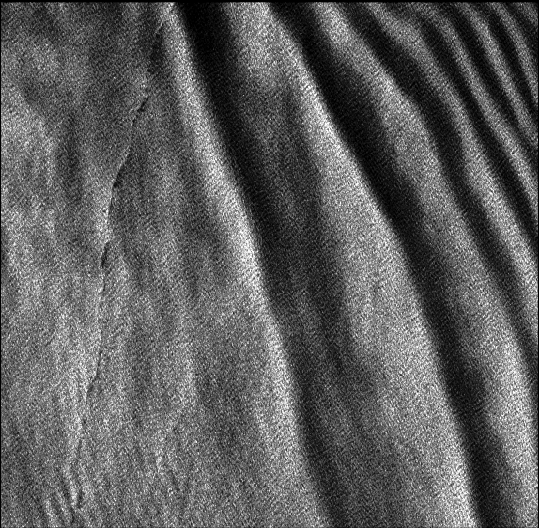
Sentinel-1 Wave mode acquires 20 km by 20 km vignettes at 5 m resolution along the satellite orbit. A machine learning model trained on an expert-curated dataset classifies each one for the alternating bright and dark banding that marks an ISW packet.
Every positive is then adjudicated by a domain expert. There is no independent ground truth for internal waves in radar imagery, so the expert is the reference standard. That adjudicated set becomes both the published catalogue and the material the model retrains on, so the service sharpens as the record grows.
Imagery is held in S3-compatible object storage and the associated metadata in a relational database, an architecture built to absorb the volumes Sentinel-1 produces and to keep classification close to acquisition.
Built for the whole ocean
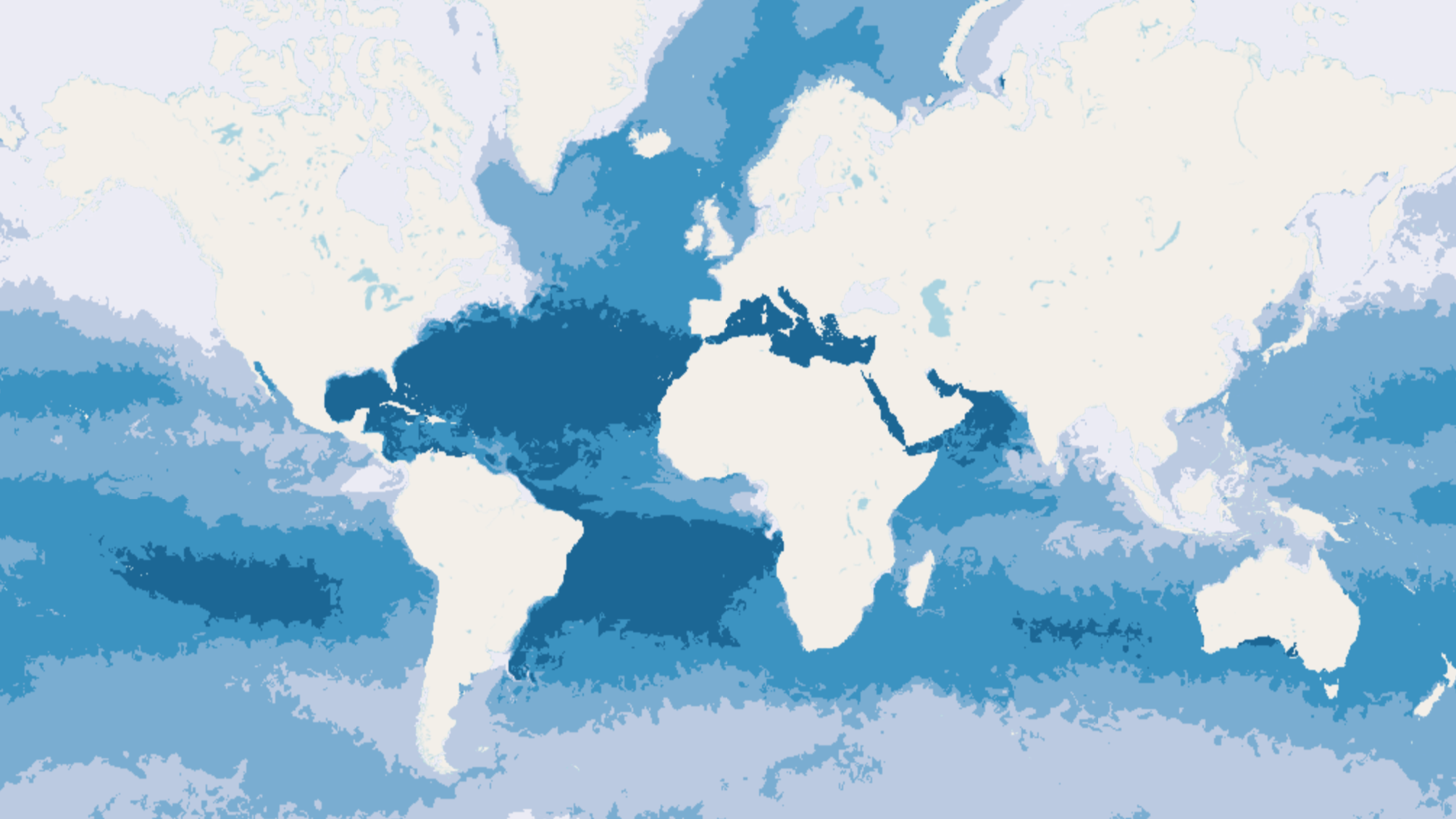
The IWS was designed with the global ocean in mind. Wave Mode provided the starting point because its systematic sampling of the open ocean offered an ideal basis for establishing an operational service. Future developments will expand the observational coverage, particularly towards shelf and coastal regions, where internal waves are especially widespread and dynamically important, including through the use of Sentinel-1 Interferometric Wide (IW) swath mode.
What comes next
The IWS is designed as an evolving platform, with new capabilities developed as the observational record, methods and scientific community grow.
Ongoing developments aim to move beyond detection towards the characterization of internal waves, including parameters such as wavelength, propagation direction and amplitude. Expanding observational coverage beyond Sentinel-1 Wave Mode, particularly towards coastal and shelf regions, is another important area of development.
The growing IWS record also creates opportunities to explore synergies with complementary satellite and in situ observations, investigate data from other current and future Earth observation missions, and revisit historical satellite archives.
These developments will be guided by scientific priorities, data availability, methodological readiness and input from the international IWS community.
Community
The IWS is built with an international network of institutions working in physical oceanography, modelling, Earth observation and satellite missions.
The first Internal Waves Service Workshop met in Angra do Heroísmo, Azores, in April 2025, and its outcomes are published in the Bulletin of the American Meteorological Society.
The second workshop met in Lisbon in April 2026.
Partners: