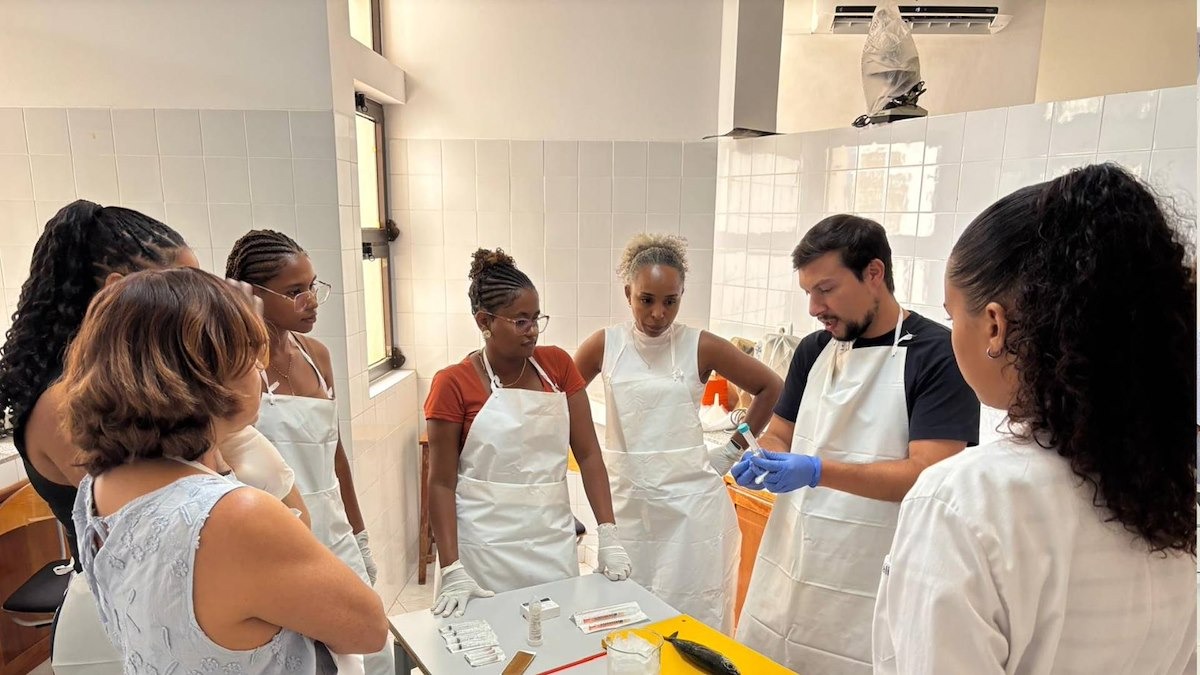
Between 7 and 12 September, partners of the BioAquaCV (Development of Biomarkers and Analytical Procedures for Aquaculture in Cape Verde) project gathered in São Vicente, Cabo Verde, for the initiative's first field mission. The project brings together the AIR Centre, the University of Aveiro's Centre for Environmental and Marine Studies (CESAM) and Cabo Verde's Institute of the Sea (IMar).
The visit focused on strengthening local capabilities for aquaculture research and monitoring, combining technical training, knowledge exchange, and engagement with stakeholders across the sector. By working directly with IMar staff and local aquaculture actors, the project is helping build the expertise and tools needed to support more informed management and development of aquaculture activities in Cabo Verde.
A central ambition of BioAquaCV is to make scientific approaches more accessible and operational, adapting monitoring methods and analytical procedures so they can be readily applied in local production settings. Through this approach, the project seeks to support the generation of consistent data and practical information that can benefit both researchers and producers.
The mission also created opportunities to strengthen ties between research institutions and the aquaculture community, opening the door to future collaboration on topics such as animal health, production performance, environmental monitoring, and sector sustainability.
As part of broader efforts to rebuild research capacity after Tropical Storm Erin in 2025, the AIR Centre supported the acquisition of laboratory equipment through the BioAquaCV project.
This first mission marks an important milestone for the project, laying the groundwork for continued cooperation, stronger technical capacity, and the development of solutions tailored to the needs of Cabo Verde's growing aquaculture sector.
[PC 28 September 2026]

 News