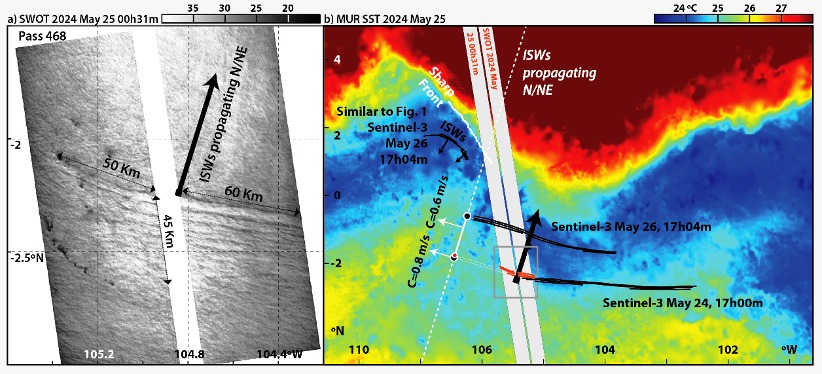
A new article co-authored by the AIR Centre has showcased a new research uncovering long-lived Internal Solitary Waves with global climate implications.
“Longevity of Internal Solitary Waves in the Pacific Cold Tongue: Synergies with SWOT”, lead by Professor José C. B. da Silva (University of Porto), and co-authored by Jorge Manuel Magalhães (CIIMAR), Adriana M. Santos-Ferreira (AIR Centre), and Renan Huerre (IMT Atlantique), was accepted for publication in the renowned journal Remote Sensing of Environment.
Internal Solitary Waves (ISWs) are large-scale oceanic phenomena that play a crucial role in vertical mixing, ocean circulation, and marine ecosystems. Although well documented in several parts of the globe, their presence and persistence in the Pacific Cold Tongue, a key region of the equatorial Pacific, were until recently largely unexplored.
Thanks to data from the SWOT (Surface Water and Ocean Topography) satellite, combined with imagery from Sentinel-3 and other sensors, the research team was able to track the propagation of these waves over several days. The study shows that these waves can persist for more than 48 hours and cross the entire meridional width of the Pacific Cold Tongue, challenging previous hypotheses that suggested faster dissipation.
These results demonstrate that internal solitary waves can transport energy and information across hundreds of kilometers. This has significant implications for our understanding of ocean dynamics, climate variability, and human activities at sea, including navigation and fishing. The study also reinforces findings reported by the new monitoring platform -
Internal Waves Service (IWS), which has identified this region as a hotspot for internal solitary waves. The
Internal Waves Service (IWS) is a collaborative effort of over 23 institutions worldwide and led by the AIR Centre; it continuously monitors the globe for internal waves in near real time, combining radar observations from Sentinel-1 with machine learning techniques (
BAMS paper).
The full article is available
here.

 Collaboration