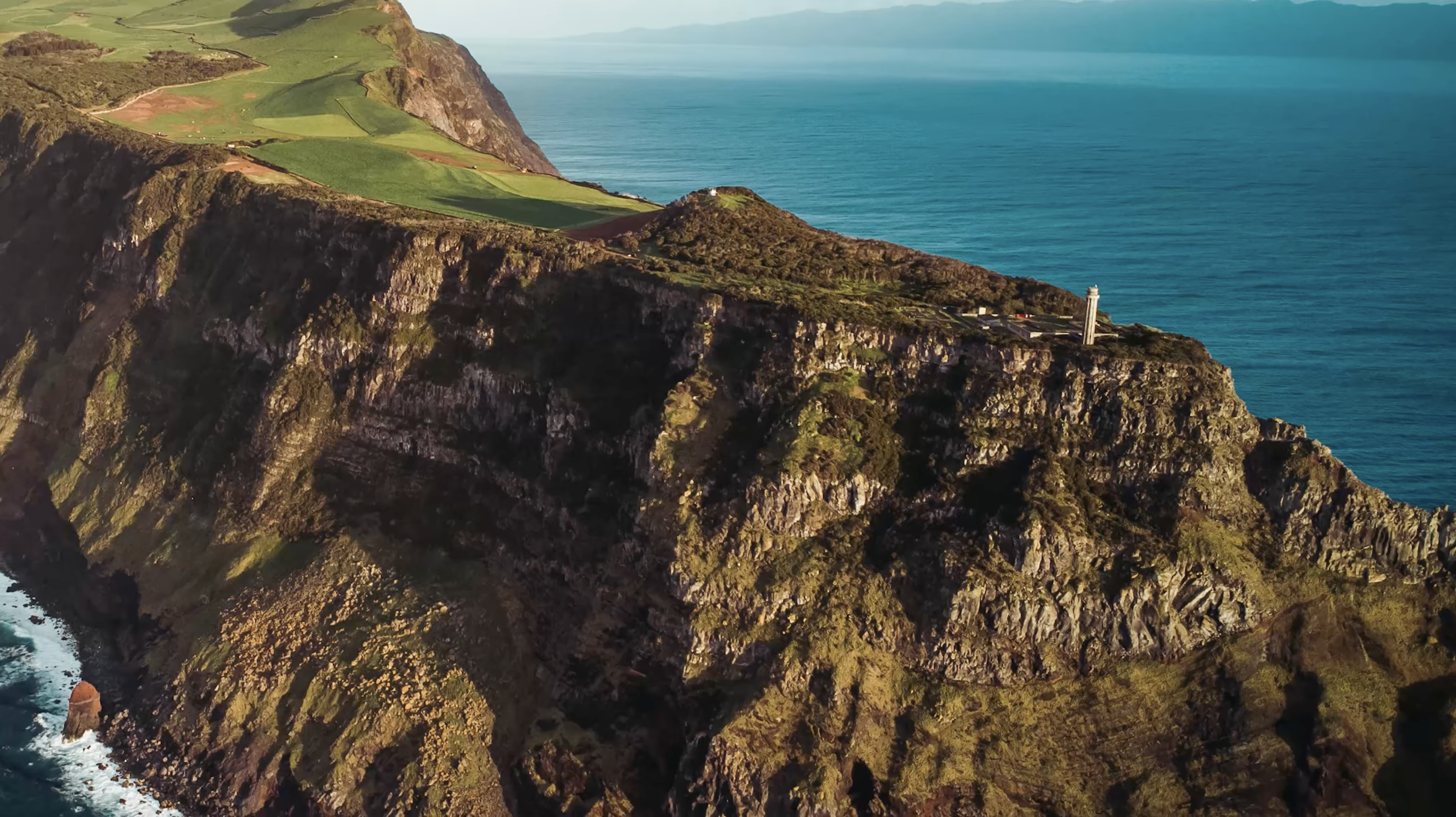
An international team studied a powerful volcano-tectonic unrest event affecting São Jorge Island in the Azores in March 2022, creating alarm in the population and being followed daily by the regional civil protection authorities.
Using high-resolution earthquake locations from land and ocean-bottom seismometers and ground deformation from satellite radar and GPS data, the researchers reconstructed the detailed underground movement of magma. They found that a vertical sheet of magma, known as a dike, rose rapidly from more than 20 km below the surface before stalling just 1.6 km beneath the island. Much of this ascent occurred with little seismic activity, with most earthquakes occurring after the magma stopped ascending.
“This was a stealthy intrusion,” said Lead Author Stephen Hicks from University College London. “Magma moved quickly through the crust, but much of its journey was silent, making it difficult to forecast whether an eruption would occur.”
Satellite observations showed that the volcano's surface rose by 6 cm, confirming that magma had entered the shallow crust. However, the intrusion stalled before reaching the surface, resulting in what scientists define as a “failed eruption”. Such intrusions help to grow islands and this study’s unprecedented sharp earthquake maps show how this happens.
The magma rose through one of the island’s main fault systems, the Pico do Carvão Fault Zone. By studying geological traces left by ancient earthquakes, scientists had previously found that this fault system has produced large earthquakes in the past. But instead of a single large earthquake, the unrest from rising magma produced many small earthquakes clustered along this fault.
The team interpreted that the fault helped guide magma upward and may also have allowed gases and fluids to escape sideways, lowering pressure in the magma and helping halt its ascent. “The fault acted like both a highway and a leak,” said Pablo J. González, the study's co-lead author, from the Spanish National Research Council (IPNA-CSIC) in Tenerife. “It helped magma rise, but may also have prevented an eruption.”
The findings show that large magma intrusions can occur rapidly and with limited warning, and that major geological faults can strongly influence whether magma erupts or stalls underground, key insights for improving volcanic hazard forecasting. “This study supported local authorities in assessing a potential volcanic threat, highlighting the value of combining onshore and offshore geophysical data for accurate detection and localisation of seismic events and ground deformation”, said Ricardo Ramalho, a co-author from Cardiff University.
“Securing urgent NERC funding to access equipment from its Geophysical Equipment Facility (GEF), alongside additional support from Portugal, was a tremendous collective effort and a clear example of transnational cooperation between academic and civil institutions in Portugal, the UK, and Spain”, said Ana Ferreira, co-author from UCL.
This work was funded by research grants from the Natural Environment Research Council (NERC; UK), European Research Council (ERC), Fundação para a Ciência e a Tecnologia (FCT; Portugal), Agencia Estatal de Investigación (Spain), Regional Government of the Azores, with field assistance for the offshore deployment provided by the Portuguese Navy (Marinha Portuguesa). Geophysical equipment was provided by NERC’s Geophysical Equipment Facility (GEF; Seis-UK for seismometers and OBIC for ocean bottom seismometers).
The following institutions were involved in the work: University College London (UCL; UK), Spanish National Research Council (IPNA-CSIC; Spain), Cardiff University (UK), University of Manchester (UK), Universidade de Lisboa (Portugal), Instituto Politécnico de Lisboa (Portugal), University of Évora (Portugal), University of Beira Interior (Portugal), Centro de Informação e Vigilância Sismovulcânica dos Açores (CIVISA; Portugal), University of Algarve (Portugal), Instituto Português do Mar e da Atmosfera (IPMA; Portugal), AIR Centre (Portugal), C4G (Portugal).
Access full article
here.
[MM, 23 April 2026]

 Collaboration