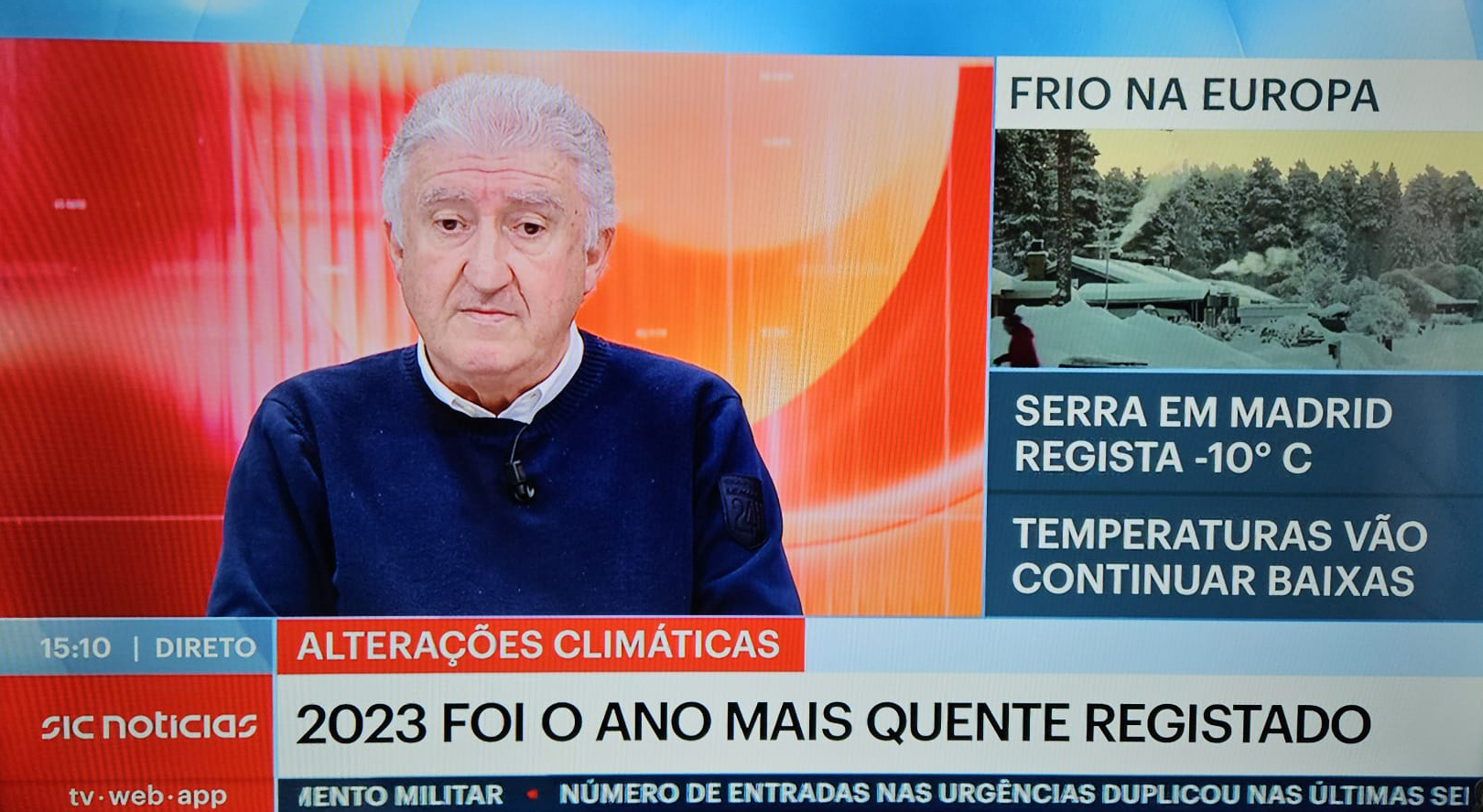
Data on the Copernicus’ report on Global Climate has shown that 2023 was the hottest year ever recorded, a milestone that highlights the urgent need to employ stabilisation measures to adapt to these climate changes, as stated by AIR Centre’s Executive Director, Miguel Miranda, in interviews for SIC Notícias and CNN.
Although the winter has been harsh, mainly in Europe, 2023 has surpassed, by 1.5 degrees the temperature levels of the pre-industrial era. This milestone means that, from now on, it will be increasingly complicated to mitigate the effects of the great variability and extreme weather phenomena we have been experiencing. It is especially urgent, more than the effects of snowstorms occurring in large, wealthy cities, to mitigate impacts like the destruction of the soil in regions where the population depends on it to feed. For these populations, the change of climate has posed dramatic scenarios.
“We are not talking about “reducing”, we are talking about “maintaining”, and we are not talking about “recovering what was lost”, we are talking about “finding stability”. This is to say that if we find some stability, we will be able to adapt. If not, we will face harder conditions with each passing year.”, mentions Miguel Miranda, geophysics professor and Executive Director of the AIR Centre, in interviews to television channels, SIC Notícias and CNN.
The future implies a different world, a world capable of better managing the climate, capable of changing to more resilient structures, in a way that can maintain the economy and social systems. There’s a long way to go, there are important social costs associated, and in many cases it’s not possible to imply restrictions, namely in more vulnerable sectors of the population. It is mandatory that we find a path that is inclusive, but that allows for us, and the effects we cause, to quickly stabilise.
Even though the report mentions that greenhouse emissions continued to increase last year, it does not mean that the measures previously adopted had no effect. They have been especially relevant in Europe and most economies from the Northern Hemisphere, however, until effective changes are made in energy production systems and transports, greenhouse emissions will continue to increase. While there are some positive signs already, it is still too soon to expect significant changes.

 Collaboration