The Portuguese Navy training vessel NRP Sagres set sail from Lisbon on 30 April on a voyage to the United States, having arrived on 27 May. This journey carries a scientific dimension that is close to our work at the AIR Centre.
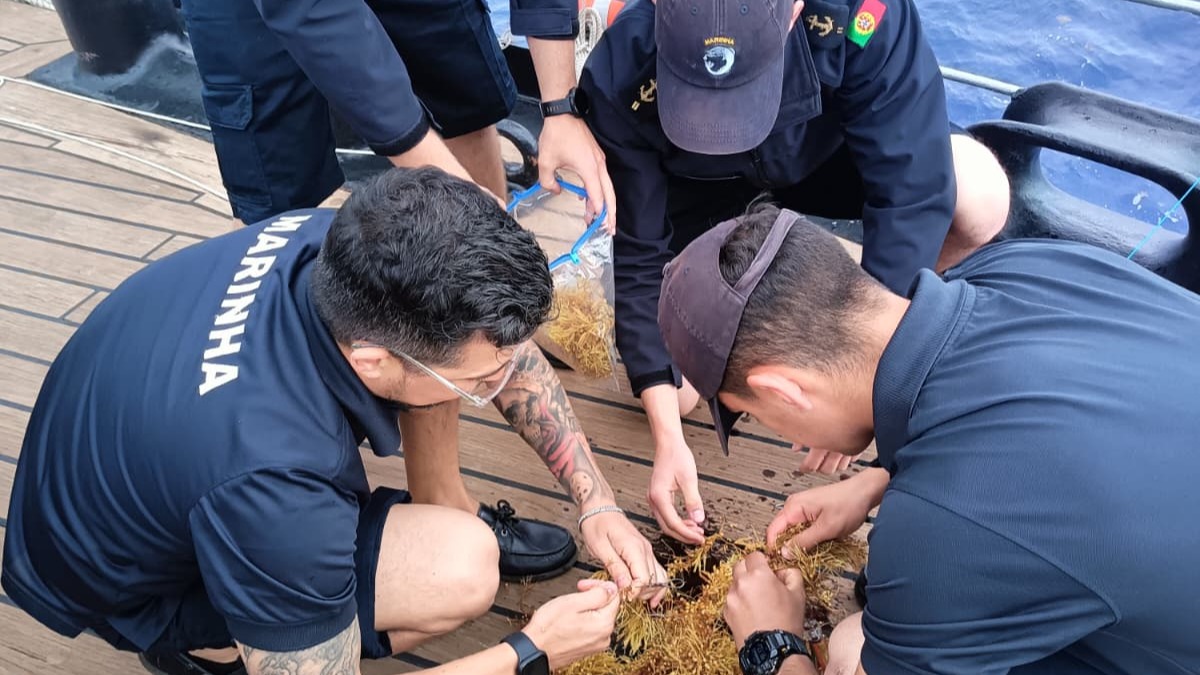
As the ship crosses the Atlantic, researchers on board will be collecting Sargassum samples and capturing georeferenced photographs of this macroalgae at sea. The processing of the samples and images acquired will be a joint effort between the University of Porto/ LSTS - Underwater Systems and Technology Laboratory, Columbia University and the AIR Centre. These images will serve a critical purpose: validating satellite imagery used to monitor the Great Atlantic Sargassum Belt — a massive floating ecosystem stretching from the west coast of Africa all the way to the Caribbean.
At AIR Centre, in collaboration with researchers from Mexico, we are working on improving the Earth Observation-based detection of Sargassum across the Atlantic. Since 2011, unprecedented Sargassum inundations have been causing devastating impacts on Caribbean coastal ecosystems, with severe economic and public health consequences. In recent years, the African coast has also been experiencing increasingly severe Sargassum flooding events.
Tackling this challenge requires progress on multiple fronts: improving satellite detection algorithms, refining transport modelling, and building more effective early warning systems. The georeferenced photographs collected during this NRP Sagres mission are precisely the kind of ground-truth data that allows us to validate and improve satellite-derived Sargassum detection.
Learn more about it here.
[AF, 15 June 2026]
 Research