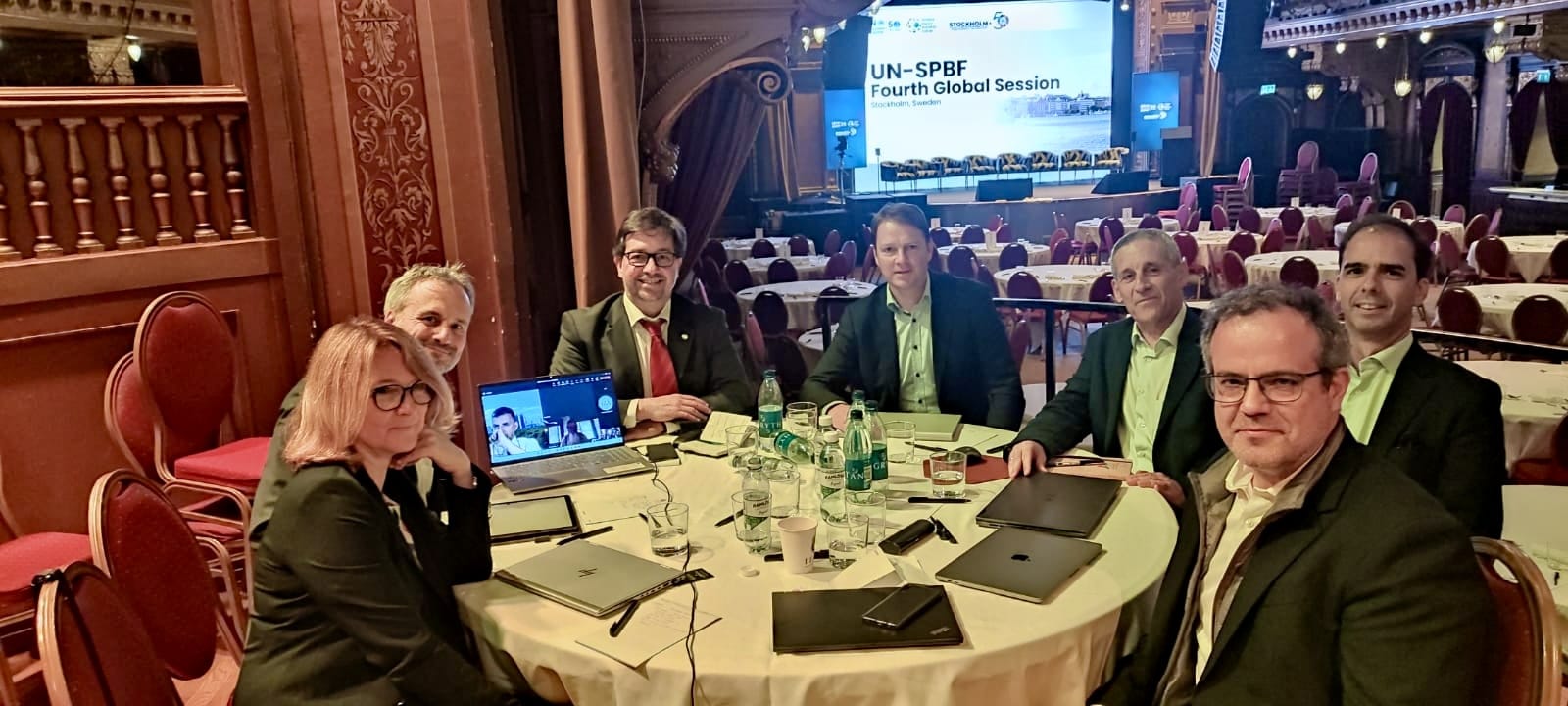
The AIR Centre has signed a Memorandum of Understanding (MoU) with the United Nations Environment Programme (UNEP) to create the GRID Azores. This new GRID Centre will help assess environmental issues with data from satellites, and develop new tools and methods to aid decision making. In addition, it will work towards strengthening knowledge transfer and capacity building to contribute to the preservation of marine and coastal ecosystems in the Atlantic Region. Ultimately, all these efforts aim to improve the lives of people around the Atlantic Ocean and beyond. The AIR Centre EO Lab met in Stockholm on 31st May 2022, for a strategy review as well as to define the work plan for the upcoming next 12 months.
GRID: providing reliable environmental knowledge for a sustainable future
The Global Resource Information Database (GRID) is a worldwide network of environmental data centres created by the UNEP in 1972. The main functions of a GRID Centre are to acquire data, transform it into information, and disseminate this information to support environmental governance and policies. GRID Centres handle and analyze data on environmental and natural resource issues through Geographic Information Systems (GIS), remotely sensed imagery and
in-situ data. These Centres process, integrate, disseminate and communicate geographic information via interoperable data platforms, through other online technologies including interactive graphs or maps as well as via contributions to reports on various topics related to the environment.
UNEP is establishing the World Environment Situation Room (WESR) to support countries tackling environmental emergencies and achieving the SDG 2030. In a User-Centered and Demand-Driven- Approach, the WESR under development is expected to reach a fully-fledged Federated Data System by 2030. The goal is to have a network of data, users, applications, and knowledge in a place where data flows bi-directionally across organizations, data providers, and platforms.
A MoU that strengthens the ability to support policy making based on evidence
With this MoU, the AIR Centre becomes one of the 9 GRID Centres worldwide and the first in the Atlantic region, becoming part of the spine of “One Global Partnership” supporting UNEP to transform big data into information and knowledge for sustainable development and humanitarian action at the global, regional and national levels.
The AIR Centre, headquartered on Terceira Island - Azores, is established as a distributed network that already includes several countries in Africa (South Africa, Nigeria, Angola, Namibia, Cape Verde and São Tomé and Príncipe), the Americas (Brazil, Colombia, Mexico and United States of America) and Europe (Portugal, Spain, United Kingdom and Norway).
The AIR Centre EO Lab participates in more than 20 projects in international consortium, with entities from associated countries (including companies, universities, and research centres), approved in international competitions (National, European, and Intercontinental programs) on issues related to the oceans such as desalination, offshore renewable energy, protection of marine ecosystems, detection of plastics in the oceans from satellite, ports of the future, coastal cities, aquaculture, among others.
The GRID Centre Network representatives meeting in Stockholm
The AIR Centre, represented by Miguel Belló, Pedro Silva and João Pinelo, participated in the UNEP GRIDs Network Meeting on the 31
st of May in Stockholm to present and discuss the implementation status and strategy of the GRID network and pilot projects as well as to agree on the implementation work plan for the next 12 months. All 8 representatives from GRID Centres participated: Abu Dhabi, Arendal, Geneva, Azores, China, Nairobi, Sioux-Falls and Warsaw.
Contacts:
Pedro Silva, Chief Technology Officer – Earth Observation Laboratory | Atlantic International Research Centre
Email:
pedro.silva@aircentre.org
 Collaboration