KwaZulu-Natal 2022 Floods cause Major influx of Debris into the Ocean

KwaZulu-Natal 2022 Floods cause Major influx of Debris into the Ocean

On April 2022, extreme flooding in KwaZulu-Natal province resulted in one of South Africa’s most destructive disasters with massive accumulation of debris on local beaches and likely a vast inflow into the ocean as detected by the AIR Centre’s POS2IDON satellite tool. During 11–12 April 2022, extreme rainfall hit South Africa’s east coast, causing major flooding and landslides across KwaZulu-Natal province (1,2,3). With over 400 deaths reported, and more than 13,000 houses and 100 schools estimated to be damaged or destroyed, the event was one of the deadliest and most destructive disasters in the recent history of South Africa. The severe floods caused a significant influx of debris into the coastal zones, originating from the river catchments and poor waste management. A clear consequence was the extensive quantity of debris, particularly plastics, accumulated on the local beaches. With a high likelihood, an enormous amount of debris had also entered the ocean. However, limited information exists on the locations and quantities of floating debris drifting in the vast coastal ocean, where they represent a threat to fisheries, navigation, and the overall marine ecosystem.
Marine debris washed ashore on the coast of Durban (credits: Clean Surf Project)
In the aftermath of such a flooding disaster, the detection of floating debris in the ocean is especially crucial. It allows the assessment of the locations and fate of the debris, understanding of plastic inputs, alert stakeholders, and inform further actions and mitigation strategies by local authorities. Here, satellite detection methodologies play a key role in determining what is the possible scenario once litter and other land-based material enter the sea, affecting human activities and biodiversity, where spare in-situ information is not able to seize the full extent of the problem.
Visual observation of very high-resolution images of the coast of Durban, showing the offshore transport of material by river plume. A major debris item, possibly a tree log around 10 m long, is seen in the image (inset B). Satellite image acquired via Maxar Open Data Program (LICENSE)
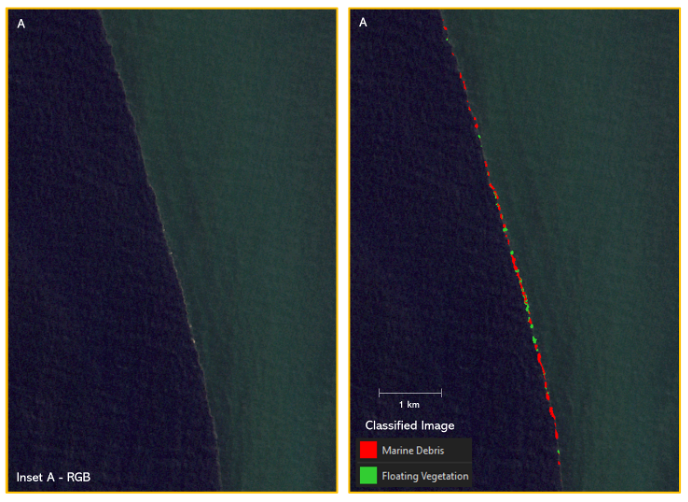
To prove the potential of satellite detection, the POS2IDON (4) tool, developed by the AIR Centre, using Sentinel-2 imagery, was tested on the flooding events that hit KwaZulu-Natal and Durban. The pipeline was employed to detect the presence of floating debris, along the coast of Durban, on a Sentinel-2 image acquired on the 20th of April 2022. Results show several filament-like structures classified as accumulation zones of marine debris (highlighted in red), likely to also include considerable accumulations of plastic, further confirming the spread of debris into the ocean.
Satellite-detected marine debris on Sentinel-2 images off the coast of Durban, can contain plastic litter together with other debris
POS2IDON is a new automated pipeline, bringing together several machine learning models, trained with a state-of-the-art spectral signatures library, different satellite data providers, atmospheric correction, and masking in a single, user-oriented tool. It can be applied to different regions and allows the detection of large features that can be suspicious in terms of aggregation of floating debris, such as plastics, and thus be used to alert and inform stakeholders.

Reference:

1 https://www.wits.ac.za/news/latest-news/general-news/2023/2023-04/the-2022-durban-floods-were-the-most-catastrophic-yet-recorded-in-kwazulu-natal.html
2 https://www.dailymaverick.co.za/article/2022-06-14-huge-volume-of-plastic-flood-debris-trapped-inshore-by-agulhas-current/
3 https://www.euronews.com/video/2022/04/21/south-africa-thousands-of-plastic-bottles-litter-beach-following-catastrophic-floods
4 A. Valente, E. Castanho, A. Giusti, J. Pinelo and P. Silva, "An Open-Source Data Pipeline Framework to Detect Floating Marine Plastic Litter Using Sentinel-2 Imagery and Machine Learning," IGARSS 2023 - 2023 IEEE International Geoscience and Remote Sensing Symposium, Pasadena, CA, USA, 2023, pp. 4108-4111, doi: 10.1109/IGARSS52108.2023.10281415

Other in the text

https://www.maxar.com/open-data/southafrica-flooding22
https://www.instagram.com/cleansurfproject/
https://creativecommons.org/licenses/by-nc/4.0/legalcode

Surf Clean Project Images

https://www.facebook.com/cleansurfproject/photos/a.155189165057544/1125436274699490/
https://www.facebook.com/photo/?fbid=1135471693695948&set=a.155189165057544
Share this entry

Other News

Collaboration

Space Agencies shape regional priorities at the II Ibero-American Meeting in Madrid

calendar_today September 17, 2026

The AIR Centre took part in the II Ibero-American Space Agencies Meeting in Madrid, organised by the Spanish Space Agency on 15 and 16 September. AIR Centre’s Deputy Executive Director, Mafalda Carapuço, represented the organisation alongside heads of space agencies, universities, research centres and industry from across the Ibero-American community.

Collaboration

ATLANTICO_SARG project officially launched to tackle Sargassum impacts through science and collaboration

calendar_today September 11, 2026

On September 10, partners from AIR Centre (Portugal), UNAM (Mexico) and IMar (Cabo Verde) held the kick-off meeting for ATLANTICO_SARG, a new triangular cooperation project funded under the second Call of the SEGIB / Camões, I.P. Triangular Cooperation Fund. Held online, the meeting brougtht together researchers and representatives from all three partner institutions to address the growing impact of Sargassum seaweed flooding on Cabo Verde's coasts.

Collaboration

Australian Ambassador strengthens scientific and diplomatic engagement during visit to the AIR Centre

calendar_today September 11, 2026

The Australian Ambassador to Portugal, Dr. Helen Cheney, who also serves as Ambassador to Cabo Verde, Guinea Bissau and São Tomé and Príncipe, visited the AIR Centre on Terceira Island as part of her official programme in the Azores. The visit emphasized scientific cooperation and the growing relevance of the Atlantic in Australia’s international engagement.