REPORT SUMMARY
Historical comparison of weekly average of key air quality parameters of Particulate Matter Aerosol <10μm (PM10) and Nitrogen Dioxide (NO
2) for Lisbon, Porto and Madrid for 2018, 2019 and 2020:
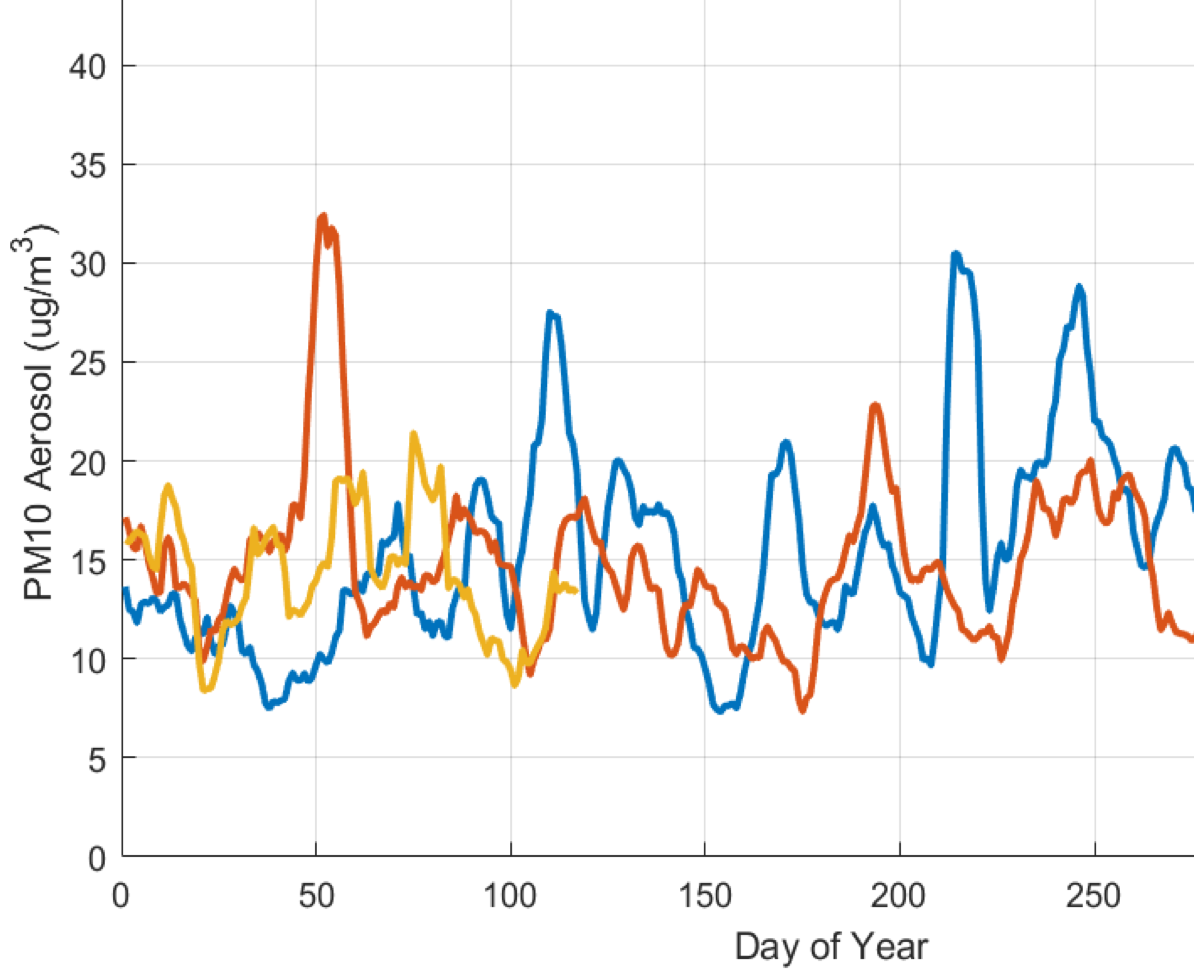
- PM10: Lisbon and Porto are at their 2-year lowest level of about 20% and a drop of 33% since COVID lock-down. Madrid has a significant drop since lockdown with current vales much below 2018 but still close to 2019.
- NO2: Lisbon has an historical minimum of the last 2 years, dropping more than 40% during most of the month of April 2020. In April, Porto is higher than the last two years but with a 50% reduction since lockdown. Madrid with a 2-year lowest level down to more than 30% and 50% since lockdown.
PARTICULATE MATTER AEROSOL
Particulate Matter <10µm (PM10) are microscopic particles of solid or liquid matter suspended in the air. These are measured in g/m3. Main sources include i) human origin such as industrial processes and product use, agriculture, commercial, residential and households; ii) natural our semi-natural sources such as desert dust, biomass burning and sea salts. The EU Ambient Air Quality Directives limits the daily average (with no more than 35 days per year) below 50 μg/m3 and annual average below 40 μg/m3. PM10 affects cardiopulmonary and respiratory health, the immune system and in last instance can cause lung cancer. Recent studies found evidence of SARS-Cov-2 RNA on PM10 air samples and other studies are pointing towards a relation between PM10 and increased mortality rate.
The concentration of PM10 was analyzed in three cities (Figure 1): Lisbon, Porto and Madrid, for the period of January-April 2020, and compared with the same period in 2019 and 2018. Comparing the results, it can be stated that for Porto, the PM10 levels are lower in 2020 than in the past two years for the end of March and April. For the last day analyzed (30 April 2020) there is a reduction of approximately 22,9% for 2019 and 2018. For Lisbon, the PM10 levels are lower in 2020 than in the past two years for April, even though there is a slight increase in some days of analysis, matching the values of 2019, but then there was a further drop in PM10 levels (reduction of 20% for 2019 and 2018, April 30). In the case of Madrid, the reduction is only being verified from the second week of April, and even so, in day 30 there was a slight increase of PM10 comparing to 2019. The main conclusion verified for the tree cities is that the concentrations of PM10 in the air are lower since the lockdown due to COVID-19 in March (33,3% for Lisbon, 33,3% for Porto and 52,6% for Madrid).
Tropospheric Monitoring Instrument (TROPOMI) data is used by CAMS service for PM10 analysis. The results were obtained with a 7 days average based on daily value determined at 14h at surface level.
Figure 1. Yearly PM10 evolution in 2018 (blue), 2019 (orange) and 2020 (yellow) for Lisbon, Madrid and Porto, respectively. Images Credit: Images generated using Copernicus Atmosphere Monitoring Service Information
NITROGEN DIOXIDE (NO2)
NO
2 is generated by vehicles, heavy industry and power plants, some of which have been shut down during the corona virus pandemic. The EU Ambient Air Quality Directives limits the concentration of 200 μg/m3 (not to be exceeded more than 18 hours per year) and annual average below 40 μg/m3. The main effects of breathing NO
2 relates to the increase of probability of respiratory problems as in high doses it could inflame the lining of the lungs and reduce immunity to lung infections, causing problems like coughing, colds and bronchitis.
The following images (Figure 2) depict yearly NO
2 emissions for Lisbon, Porto and Madrid generated using a 7-day average for daily values determined at surface level at 22h UTC using CAMS service. On April 30, NO
2 emissions are at their historical minimum since 2018 in Lisbon (reduction of approximately 4,8% for 2019 and 2018 and more than 40% in the first weeks of April) and Madrid (30,2% for 2019 and 45,5% for 2018). However, in Porto there is a significant drop in NO
2 emissions, but the current level is still above 2019 and 2018, which might be explained due to several factors such as a different rainy season. Similarly, as for the concentration of PM10, the concentrations of NO
2 in the air are lower since the lockdown due to COVID-19 in March for the three cities (20% for Lisbon, 30,7% for Porto and 50% for Madrid).
Meteorological conditions such as wind, rain and seasonal variations of boundary layer have significant impact on the concentrations of these air quality parameters.
Tropospheric Monitoring Instrument (TROPOMI) data is used by CAMS service for NO2 analysis. The results were obtained with a 7 days average based on daily value determined at 14h at surface level.
Figure 2. Historical mass concentration of Nitrogen Dioxide in air for Lisbon, Porto and Madrid for 2018 (blue), 2019 (orange) and 2020 (yellow). Images Credit: Images generated using Copernicus Atmosphere Monitoring Service Information
Disclaimer: neither AIR Centre, the European Commission nor ECMWF is responsible for any use that may be made of the information this report contains. Generated using Copernicus Atmosphere Monitoring Service Information. Contains modified Copernicus Atmosphere Monitoring Service Information 2020, 2019 and 2018
Download the report #3
here.

 Collaboration